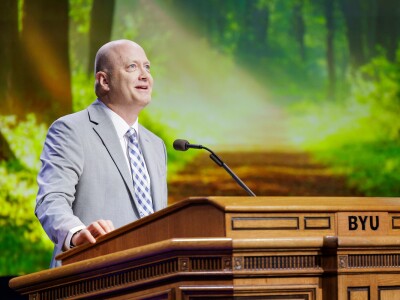
Elder Dale G. Renlund, a member of the Quorum of the Twelve Apostles of The Church of Jesus Christ of Latter-day Saints, encouraged BYU employees to strengthen the kingdom of God by building a Christlike culture on campus.
Quoting President Russell M. Nelson, Elder Renlund reiterated that the gathering of Israel is the most important work in the Church right now.
"President Nelson told the Church that the gathering is 'the greatest challenge, the greatest cause and the greatest work on earth. There is nothing happening now that is more important, that is of greater consequence. Absolutely nothing.'"

That gathering includes inviting all Heavenly Father's children to come to know Jesus Christ as their Savior, to anchor themselves to Christ and to be propelled along the covenant path that is explicit in Heavenly Father's plan. The gathering also includes literal gathering in a physical location.
According to Elder Renlund, BYU fulfills a key role in the gathering by providing a location for members to acquire intelligence.
"The intelligence we attain in this life will remain with us in the resurrection and provides advantages to the individual in the hereafter," Elder Renlund said. "This kind of teaching and learning is not limited to classrooms; it is taught by administrators and cooks, librarians and facility engineers. It can occur in a classroom even when you teach partial differential equations or poetry."
Because intelligence is eternal, the culture in which students learn at BYU is vital. Elder Renlund encouraged BYU employees to foster a Christlike campus culture by actively focusing on three distinct areas that build upon each other:
1. Testimony
Elder Renlund cautioned that if any employee were a little off-center in their testimony of the gospel, they may inadvertently lead a student away from faithfulness. All BYU employees are to help people become true followers of Jesus Christ.
"No student at Brigham Young University should be left with uncertainty about your devotion to the Lord Jesus Christ, the Restoration of His Church and the reality of living prophets and apostles."
2. Preach by Example
Citing the directive of Francis of Assisi to those who joined his monasteries, Elder Renlund encouraged faculty and staff to "preach by your deeds."
Elder Renlund acknowledged that it can difficult to act Christlike when we experience stress in our lives, and that consistently acting in a Christlike manner requires help from the Holy Ghost, a lot of patience with oneself and a lot of work.
"Overcoming the spiritual inertia that is referred to as ‘the natural man’ requires effort. Otherwise nothing changes."
3. Convey the Culture
Developing a culture of Christlike attributes does not happen in isolation or by cloistering together, chanting mantras. The culture can only exist and continue to thrive when those within the culture commit daily to live the culture and convey it to other people.
According to Elder Renlund, BYU employees have frequent opportunities to convey BYU's Christlike culture in brief but significant moments.
"Students will watch you for years, even decades. They will hear about you from future students. They will hear about you from other academics. They will hear about you from your children and grandchildren. But be assured, they will watch. And you will have the opportunity to teach them by the example of your life."